If you’ve ever seen the round marks left behind after a cupping session, you may have wondered: what exactly is cupping therapy doing?
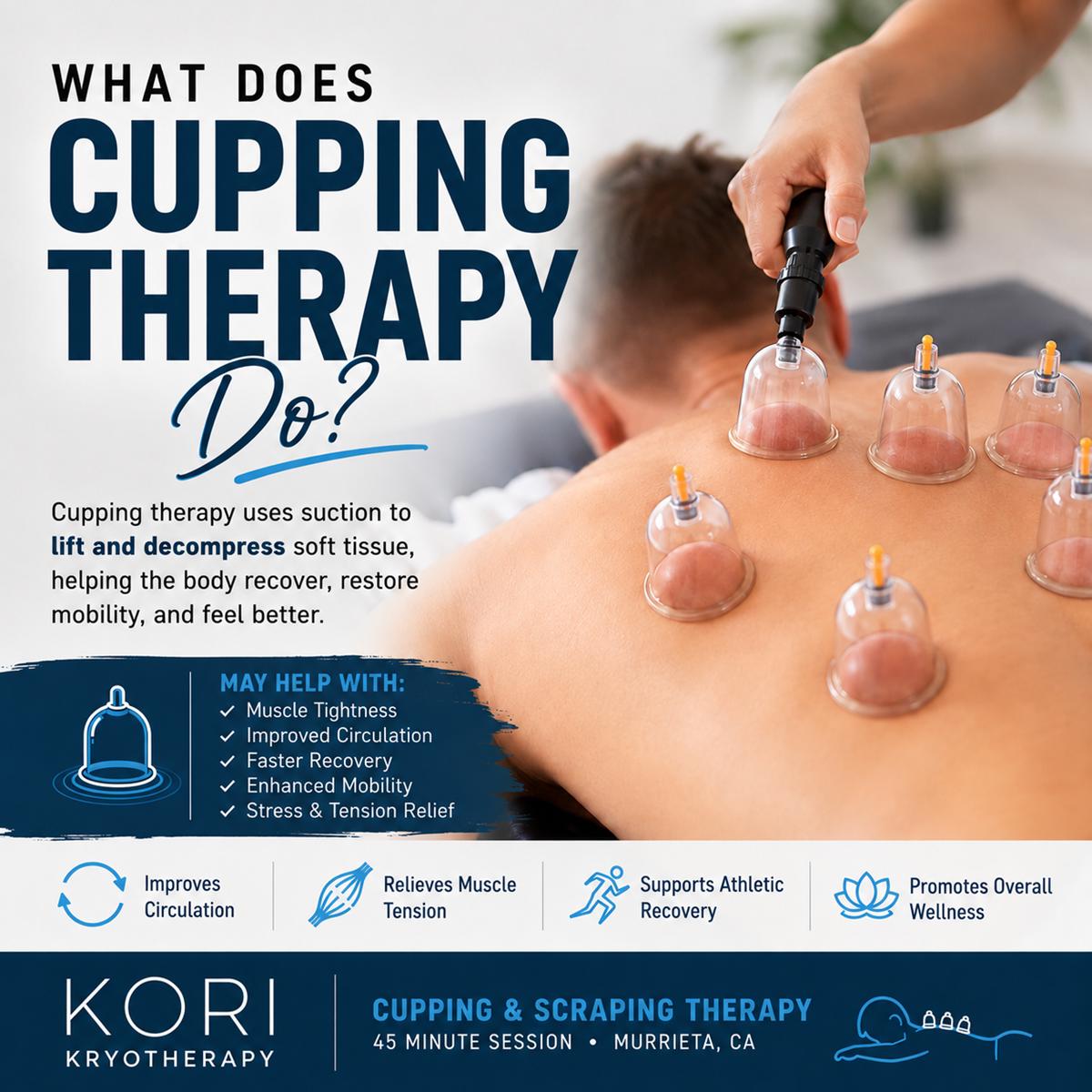
Cupping is a recovery technique that uses suction on the skin to lift and decompress soft tissue. It’s commonly used by athletes, active adults, and people looking for help with tight or overworked muscles.
At Kori Kryotherapy in Murrieta, CA, cupping is offered as part of our Cupping & Scraping Therapy service to support mobility, muscle recovery, and overall body maintenance.
How Does Cupping Therapy Work?
During cupping therapy, special cups are placed on targeted areas of the body. Suction gently pulls the skin and underlying tissue upward into the cup.
This creates a different type of pressure than traditional massage.
Instead of pressing down into tight tissue, cupping creates a lifting effect that may help:
- Reduce feelings of muscle tightness
- Improve local circulation
- Encourage relaxation of soft tissue
- Support mobility and range of motion
- Help athletes feel less restricted after training
The cups may remain in one position or be moved across the skin depending on the area being treated and the goal of the session.
Why Do People Get Cupping Therapy?
Many people use cupping as part of a regular recovery routine.
Some of the most common reasons include:
Tight or Overworked Muscles
Training, repetitive movement, desk work, and everyday activity can all leave muscles feeling tight.
Cupping may help create space within the tissue and give tight areas a different type of release than traditional stretching or massage.
Athletic Recovery
You may have noticed cupping marks on professional and Olympic athletes.
Athletes often incorporate cupping into recovery routines to help address tight muscles and maintain mobility between workouts, practices, and competitions.
It can be especially useful for sports that involve repetitive movements, including baseball, softball, football, weightlifting, running, and other high-demand activities.
What Is Scraping Therapy?
At Kori Kryotherapy, we combine cupping with scraping therapy, sometimes called Gua Sha or instrument-assisted soft tissue work.
Scraping involves using a smooth tool across targeted muscles and connective tissue.
The technique may help address areas that feel tight, restricted, or overworked.
Using cupping and scraping together allows us to approach the tissue in two different ways:
Cupping lifts and decompresses the tissue.
Scraping applies targeted pressure across the tissue.
This combination can be particularly useful when one area has been repeatedly stressed through sports, workouts, work, or everyday movement.
Why Does Cupping Leave Marks?
Those round marks are probably the most recognizable part of cupping therapy.
They occur because suction draws blood toward the surface of the skin.
The marks can range from light pink to darker red or purple and may remain visible for several days.
They are not necessarily an indication of how effective the treatment was, and darker marks don't automatically mean an area was more injured or had more “toxins.”
Your marks can also look different from one session to another.
Does Cupping Hurt?
Cupping creates noticeable suction, so you will definitely feel it.
Most people describe the sensation as tightness or pulling rather than traditional pain.
Intensity can be adjusted throughout the treatment, so communication with your practitioner is important.
Scraping can also create a strong sensation, particularly over tighter areas, but the goal isn't to make the treatment unnecessarily painful.
How Long Is a Cupping Session?
At Kori Kryotherapy, our Cupping & Scraping Therapy sessions are approximately 45 minutes.
That gives us time to focus on specific areas rather than rushing through a quick treatment.
Your session can be tailored toward the muscles or areas that need the most attention.
Is Cupping Only for Athletes?
Definitely not.
Although cupping has become very popular in sports recovery, you don't have to be an athlete to benefit from soft-tissue recovery work.
People may choose cupping because of:
- Long hours sitting at a desk
- Repetitive movements at work
- Workout-related tightness
- Stiff shoulders or back
- Limited mobility
- General muscle tension
- An active lifestyle
If your muscles regularly feel tight or restricted, cupping may be worth adding to your recovery routine.
Cupping vs. Massage: What's the Difference?
Massage typically uses pressure to push into and manipulate muscles.
Cupping uses suction to lift tissue away from the body.
That's why the experiences can feel very different.
Neither technique is automatically better. They simply work differently, and some people prefer combining different recovery methods depending on how their body feels.
Who Should Avoid Cupping?
Cupping isn't appropriate for every person or every area of the body.
It generally should not be performed over open wounds, active skin infections, or certain injured areas. People with medical conditions, bleeding disorders, or those taking medications that affect clotting should discuss cupping with their healthcare provider before treatment.
Always let your practitioner know about recent injuries, medical concerns, medications, or sensitive areas before beginning a session.
Try Cupping & Scraping Therapy in Murrieta, CA
Whether you're recovering from training, dealing with tight muscles, or simply looking for another way to support your mobility and recovery routine, Cupping & Scraping Therapy offers a different approach to soft-tissue work.
At Kori Kryotherapy in Murrieta, California, our 45-minute sessions allow us to focus on the areas that need attention and combine both cupping and scraping techniques.
Ready to see what cupping can do for your recovery routine?
Book your Cupping & Scraping Therapy session at Kori Kryotherapy.