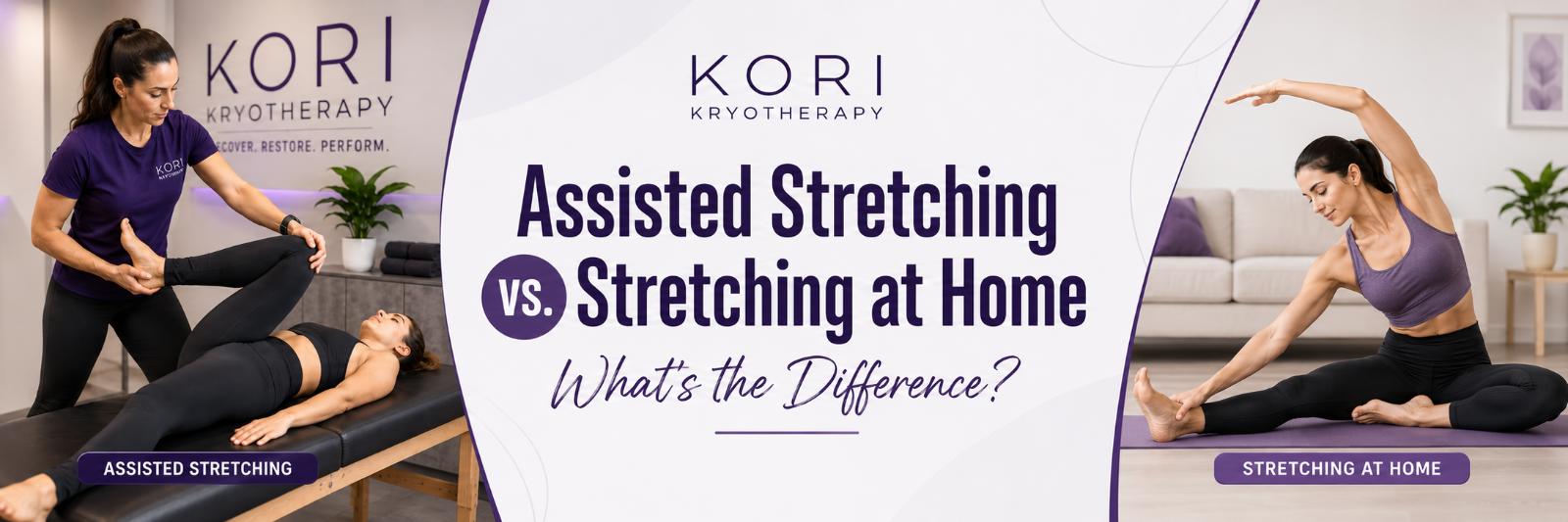
Stretching is one of those things most of us know we should do more often. But there’s a big difference between doing a few stretches on your own and having someone guide your body through a personalized assisted stretching session.
Both have a place in a healthy movement and recovery routine. The question is: when is stretching at home enough, and when might assisted stretching be worth adding?
At Kori Kryotherapy in Murrieta, CA, our assisted stretching sessions are designed to give you focused, one-on-one attention based on how your body moves and where you feel tight or restricted.
What Is Assisted Stretching?
Assisted stretching is a form of guided stretching in which a trained professional helps move and position your body through a series of stretches.
Instead of trying to reach, hold and position yourself on your own, you’re able to relax while someone else helps control the movement.
Your session can focus on specific areas that feel tight, such as your:
- Hips
- Hamstrings
- Quads
- Lower back
- Shoulders
- Chest
- Upper back
- Calves
The goal isn’t to force your body into extreme positions. It’s to work within your comfortable range while helping you move more freely.
What Is Stretching at Home?
At-home stretching is exactly what it sounds like: stretching independently without hands-on assistance.
It might include a quick morning routine, stretching after a workout, following a video, or spending a few minutes working on areas that feel particularly tight.
And there’s nothing wrong with that.
In fact, stretching at home can be an important part of staying consistent.
You can do it almost anywhere, it doesn’t require an appointment, and even a short routine can encourage you to pay more attention to how your body is moving.
The challenge is that you're responsible for your own positioning, technique and consistency.
Assisted Stretching vs. Stretching at Home
So what's actually different?
1. Assisted Stretching Is Personalized
When you're stretching at home, it's easy to follow the same stretches you've always done—even if they aren't targeting the areas that need the most attention.
During an assisted stretching session, the focus can be adjusted based on your individual needs.
Maybe your hips feel especially tight.
Maybe your shoulders feel restricted after sitting at a desk all week.
Maybe you've been training hard and your hamstrings or quads need extra attention.
Your session can be adapted accordingly.
2. You Don't Have to Do All the Work
Certain stretches can be difficult to perform effectively on your own simply because of positioning.
You may need to balance, hold your own leg, stabilize another part of your body and stretch at the same time.
With assisted stretching, someone else helps control the movement.
That allows you to focus more on relaxing into the stretch rather than trying to maintain the position yourself.
3. Assisted Stretching Can Target Hard-to-Reach Areas
Everyone has those areas that never seem to stretch quite right.
You may feel tightness but have difficulty figuring out exactly how to target it.
A guided session can provide different positions and angles that may be difficult to reproduce by yourself.
This is one of the biggest reasons some people notice that assisted stretching feels very different from their normal home routine.
4. Technique Matters
You've probably seen people stretch by bouncing aggressively, twisting into uncomfortable positions or forcing themselves farther because they think deeper automatically means better.
It doesn't.
Stretching should be controlled.
With assisted stretching, another person is helping manage your positioning and the intensity of the stretch.
At home, you have to monitor those things yourself.
If something causes sharp pain or feels wrong, you should stop rather than trying to push through it.
5. At-Home Stretching Wins for Convenience
This is where home stretching has a major advantage.
You can do it:
Morning. Evening. Before work. After the gym. While watching TV.
There is no appointment required.
That makes at-home stretching particularly useful for maintaining consistency between professional sessions.
Instead of thinking of assisted stretching and home stretching as competitors, it often makes more sense to think of them as two parts of the same routine.
Who Might Enjoy Assisted Stretching?
You don't have to be an athlete to benefit from a guided stretching session.
Assisted stretching can be a great addition to a recovery routine for people who:
- Exercise regularly
- Play sports
- Spend long hours sitting
- Perform repetitive movements at work
- Feel generally tight or stiff
- Want to improve their mobility routine
- Have trouble staying consistent with stretching
- Aren't sure which stretches to do
- Simply enjoy hands-on recovery services
Is Assisted Stretching Good for Athletes?
Athletes place repetitive demands on their bodies through training, practices and competition.
Running, lifting, throwing, jumping and changing direction can all leave certain muscle groups feeling tight.
That's why mobility and recovery work can become an important part of an athlete's overall routine.
Assisted stretching provides dedicated time to focus specifically on mobility rather than trying to squeeze a few rushed stretches in after practice.
Whether you're involved in baseball, football, soccer, cheer, gymnastics, running, weight training or another sport, it can be another tool in your recovery routine.
Does Assisted Stretching Replace Stretching at Home?
No—and ideally, it shouldn't.
Think about it like this:
At-home stretching = maintenance and consistency
Assisted stretching = focused, personalized attention
The two can work together.
Someone might have an assisted stretching session and then continue with simple stretches at home between appointments.
That's often much more realistic than expecting one stretching session to permanently change the way your body feels.
How Long Is an Assisted Stretching Session?
At Kori Kryotherapy, our Assisted Stretch Therapy sessions are approximately 45 minutes.
That gives us time to work through multiple areas of the body and spend additional time on areas that may need more attention.
Unlike squeezing five minutes of stretching into the end of a workout, the entire appointment is dedicated to stretching and mobility.
Which Is Better: Assisted Stretching or Stretching at Home?
There isn't one answer that works for everyone.
Choose stretching at home when you want:
- Convenience
- A simple daily mobility routine
- Something you can do anywhere
- A way to stay consistent between appointments
Consider assisted stretching when you want:
- One-on-one guidance
- A personalized stretching session
- Help with positioning
- More focused attention on tight areas
- Dedicated time for mobility and recovery
And you don't necessarily have to choose between them.
The best stretching routine may include both.
Assisted Stretching in Murrieta, CA
If your normal stretching routine consists of reaching for your toes for 15 seconds and calling it a day, it might be time to experience something different.
At Kori Kryotherapy in Murrieta, California, Assisted Stretch Therapy gives you 45 minutes of focused, one-on-one stretching designed around your body and your mobility needs.
Whether you're an athlete, spend most of your day sitting, work on your feet or simply want to move more comfortably, assisted stretching can be a great addition to your wellness and recovery routine.
Ready to experience the difference between stretching yourself and being professionally stretched?
Book your Assisted Stretch Therapy session at Kori Kryotherapy.